Friday, March 27, 2009

Dr. Sponenberg

D. P. Sponenberg, DVM, PhD, Veterinary College, VPI, Blacksburg, VA 24061

"SUMMARY

The Sulphur Herd Management area horses that are present as adopted horses in the Salt Lake City area appear to be of Spanish phenotype. The horses were reasonably uniform in phenotype, and most of the variation encountered could be explained by a Spanish origin of the population. That, coupled with the remoteness of the range and blood typing studies, suggests that these horses are indeed Spanish. As such they are an unique genetic resource, and should be managed to perpetuate this uniqueness. A variety of colors occurs in the herds, which needs to be maintained. Initial culling in favor of Spanish phenotype should be accomplished, and a long term plan for population numbers and culling strategies should be formulated. This is one population that should be kept free of introductions from other herd management areas, as it is Spanish in type and therefore more unique than horses of most other BLM management areas."

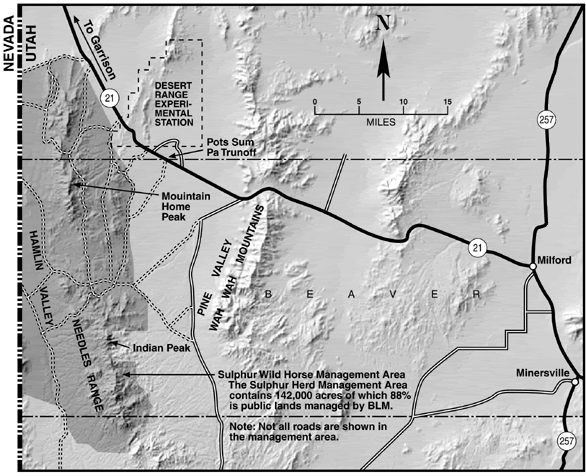
Map of the Sulphur HMA:


"BACKGROUND

Detailed historical background of the Sulphur herd management area horses is not available. The limited amount of history available points to this population being an old one, with limited or no introduction of outside horses since establishment of the population. The foundation of the herd is logically assumed to be Spanish, since this the only resource available at the time of foundation.

Spanish type includes sloping croup low set tail, deep body, narrow chest, deep Roman nosed head from side view, broad forehead but narrow face and muzzle from front view, eyes place on side of head, small ears with inwardly hooked tips, small or absent rear chestnuts, small front chestnuts, potential of long hairs on stern area and chin. All colors are possible, although a high proportion of black and its derivatives are consistent with a Spanish origin. Line backed duns, roans, buckskin/palomino, sabino and overo paint, and the leopard complex are also usually Spanish in origin, and grey and tobiano can be. It is frequently the mix of colors and their relative frequency in the population that is more important than the presence of or absence of any one color."

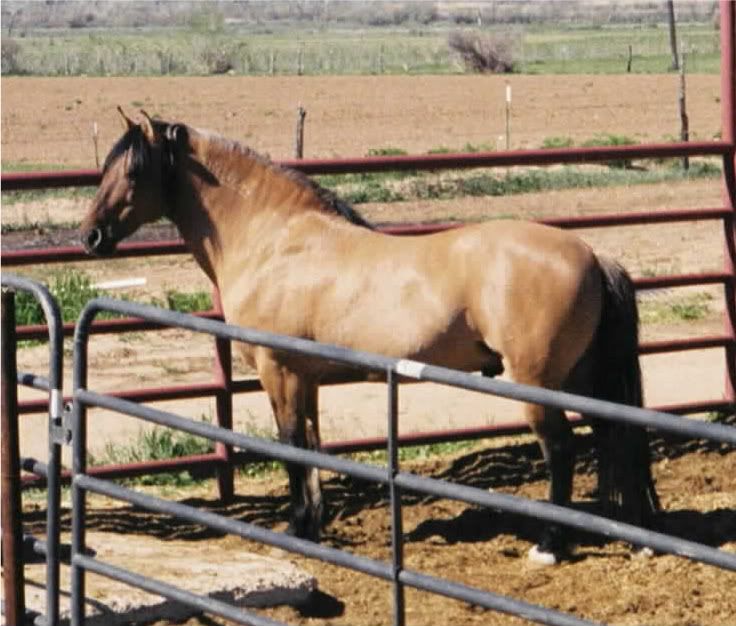
Sulphur HMA Cortez owned by Deborah Elliot of Colorado.

Tuesday, March 10, 2009

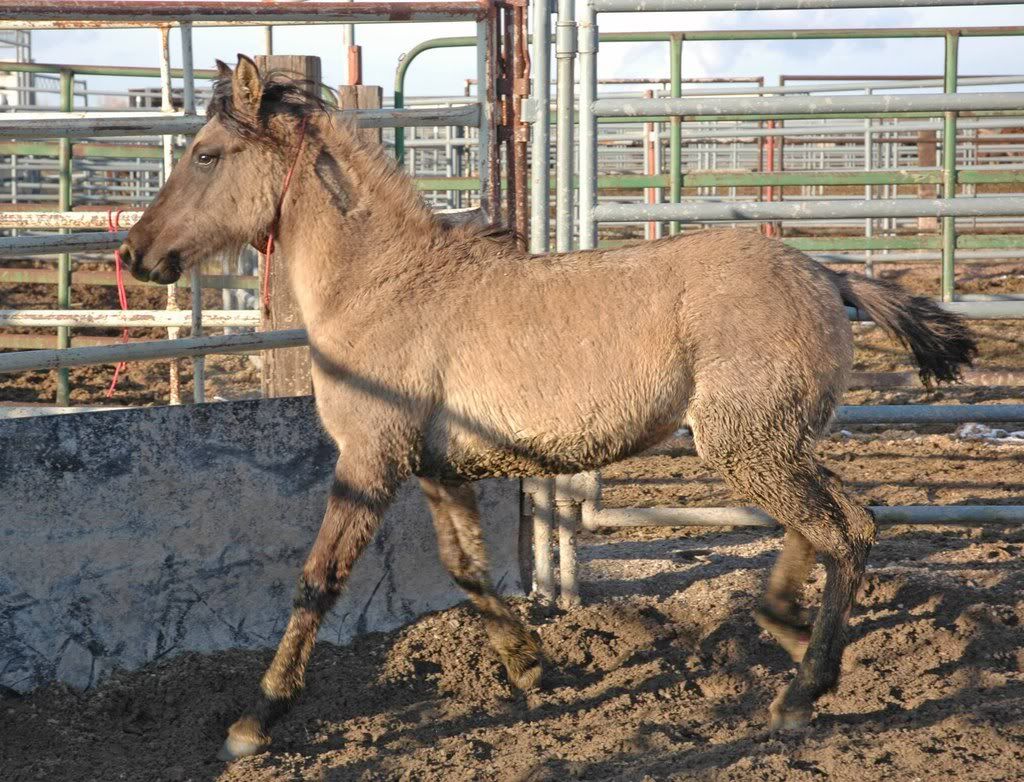
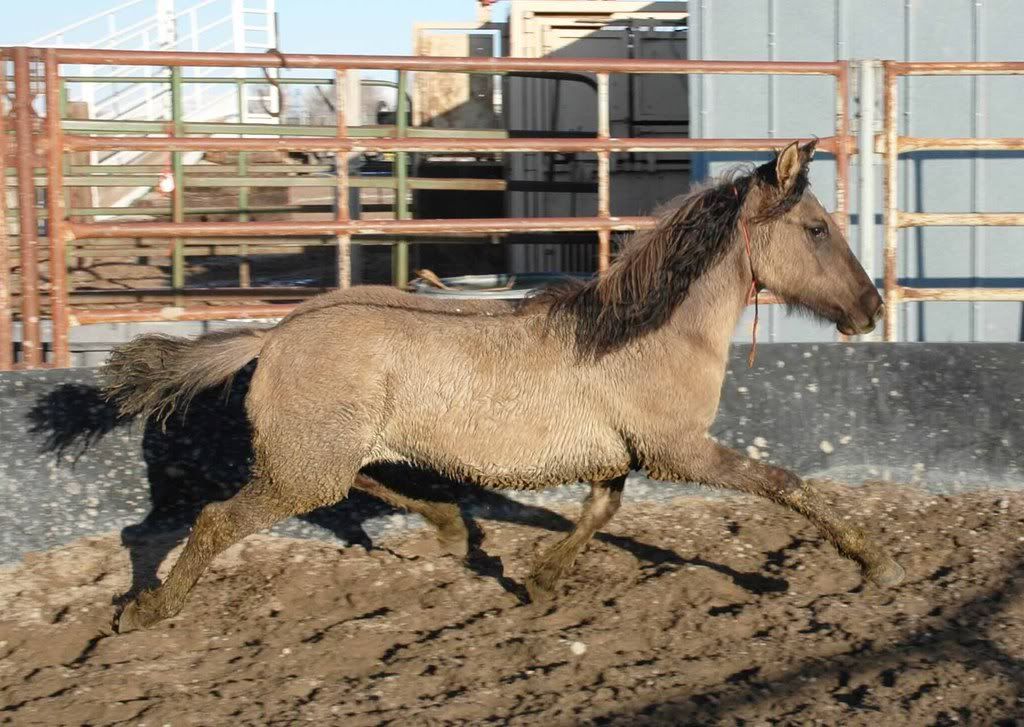
Well, I am hoping that the BLM posts more pictures of horses because right now there isn't much (or really any) of a selection of nice Spanish horses. Here is my absolute most favorite horse of the adoption so far:


I was hoping that they would post a lot more like her, but I haven't seen any. She has that nice old style Spanish Sulphur look to her. I hope to see more horses being posted that have the looks of this gorgeous girl! I also hope that the owner of the filly will contact me.

Saturday, March 7, 2009

The Blue Stallion

This story was written by Ron Roubidoux about one of his favorite stallions. Sorry, but there are no pictures that I have found of this famous stallion.

"Every horse breed has its stories of legendary stallions, stories handed down from generation to generation by word of mouth, stories immortalized in print, and stories held sacred in the hearts of individuals who possess or have lost a favorite stallion.
 
Since I started investigating Spanish Mustangs, I have come across manysuch stories whether they be in a BLM herd like the Kigers that is mistakenly touted to be "the most pure herd of Spanish Mustangs existing in the wild today" or the authentic Spanish Mustangs found in the Spanish Mustang Registry. The books I have read, like The Mustangs by 2. Frank Dobie, carried fascinating, romantic stories of legendary stallions of the past. Probably the most touching stories, to me, are the ones I have read in the SMR's Annual or were told to me by SMR members I have met. Then there are the untold stories that I can only see in the gleam of a person's eye, when they are showing me their favorite stallion, a gleam that comes from pride found deep in the heart. I may not be told, but I know there is a story there. Every owner of such a horse has a story, and that is as it should be.

As for me, my heart lies with the Sulphur horses. During the past couple of years I have devoted much of my time to the horses, to a point that they have almost become an obsession, and in doing so I have collected my own personal stories of the Sulphur stallions. Though some of these stories have a good outcome and others don't, I would like to share them with you.

When I first found out about the Sulphur horses, and decided I wanted to adopt some from the BLM, I was told of a slate grullo stallion that was caught with a bay mare, dun yearling filly, and dun filly foal. At the time, the BLM in Utah made their comparisons of the Sulphur horses with the Kigers of Oregon, and they said this stallion was as good if not better than anything in the Kiger herd. They raved about him, some saying he was two horses in one. I have yet to meet a BLM man that has seen him, and who doesn't have something good to say about "the blue stallion". They branded him number 596, and later returned him to the Mountain Home Range. They felt he was much too good a horse to put up for adoption, and wanted to keep him with the wild herd. This was during the summer of 1992.

In mid-July, the bay mare and two duns were taken to a satellite adoption held at Logan, Utah, along with forty horses from other herds. I was there with my eye on the grullo's three. No one else knew the story of the mare and her two foals, nor was there much interest, specifically in Sulphur horses, at the time. I noticed that a number of people had the dun yearling written down as their first choice, probably because of her color. At the BLM adoptions, people wanting horses must be pre-approved, and when registering for the adoption, they write their name on a ticket that is then dropped into a bucket. The tickets are later drawn from the bucket, one at a time, lottery style, and the name is called out. The first name called gets first choice of one horse and so on until all the horses are gone. Each horse has a tag tied to its neck with a number on it. The person whose name is called, calls out the number of the horse he wants, unless it has already been taken, in which case a second, standby choice can be made. All I wanted were horses number 595, 597 and 594 and there were over sixty people registered to draw for horses. The BLM man drew the first name, which starting with Ron, and stammered on the last name starting with an R. I called out "Roubidoux, 595!" The dun yearling filly was mine. The bay mare, 594, and her foal, 597 were being adopted as one, since the foal was too young to be separated from her mother. Eight names later and she still hadn't been taken. Then my daughter's boy friend's name was called and we got the mare and foal.

I later found out that 596, his mare, and the dun fillies were all blood typed. I telephoned Dr. Gus Cothran in Kentucky, and he confirmed that the two fillies were the daughters of 596, the grullo stallion. All four horses also had good Spanish markers.

After the adoption, my family and I went on a vacation. As soon as we returned home I telephoned the BLM to find out if they still had 596, as I wanted to get some pictures of him, but they had taken him back to the range the day before. I was able to get copies of a few pictures that the BLM had taken, and that was all.

The following winter the BLM was capturing horses on the Mountain Home Range and almost caught 596 a second time, but he jumped one of the trap wings, taking a couple mares with him. That was the last time he was seen. I hope he is still alive and well on the mountain, and someday I may be privileged to see him there for myself. Every time I go to the Mountain Home Range I hope to see him, but it is like looking for a needle in a haystack, because of the heavy stands of pinion-juniper. Maybe that's why they call the Mountain Home and Indian Peak Ranges of the Sulphur Herd Management Area, the Needle Range."
Thursday, March 5, 2009

Internet Adoption

30 Spanish and mixed Spanish Sulphur horses have been posted on the internet adoption site. Go here to check it out!

Internet Adoption

Don't forget about the Sulphurs that will not be on the internet adoption!

Click here to check out the other Sulphur horses.

If anyone would like my help in selecting a Spanish type horse, then I would be more than happy to help! Just send me an email.

A Picture from the Past


Sulphur's Smokey with Sulphur's Quest. Quest is by Sulphur's Chance. Sulphur's Smokey now lives with Jeff Hammer in NM.

Wednesday, March 4, 2009

Spanish Fire


Chief and Sulphur mare taken in 2008. Photo is copyrighted and not available for reproduction of any kind. Bev Pettit Photography.

Spanish Head styles

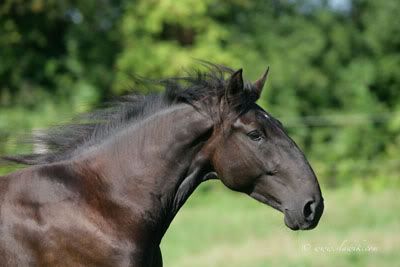
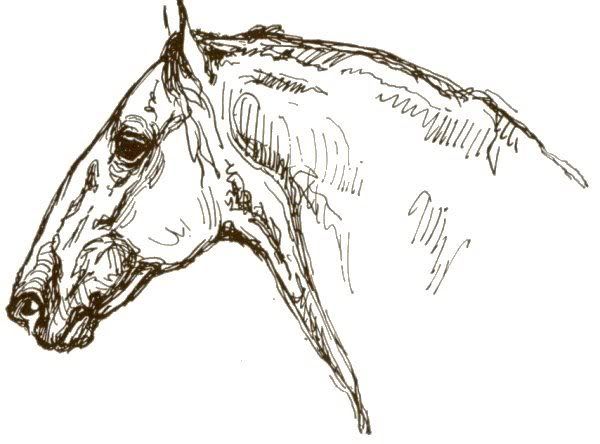
Most people have a real difference of opinion on this topic. Some prefer to believe that a Spanish head style is long, narrow between the eyes, with a convex profile. The more convex the better. I have found this type of head style to be prolific on modern Iberian horses as well as warmbloods. Giving me the impression that this head style is of non-Spanish origin. You will find it hard to find such a head style on the more old Iberian horses such as the Paso Fino, Spanish Sulphur, Peruvian Paso, etc. Which actually would do more to confirm my suspicion that this head style is indeed of non-Iberian origin.


Both of these convex head examples are of warmblood type horses influenced by Spanish horses. Which type of Spanish horse (modern which is the Andalusian and Lusitano who also have warmblood and TB flowing through their veins vs. old Iberian which would include Paso Fino, Peruvian Paso, Chilean Criollo, Spanish Sulphur, etc.) influenced these warmbloods, I don't know. Being that the modern Andalusian and Lusitano are at best only 200 years old, I am going to assume that it was a proto type PRE/PSL or an actual old Iberian horse.

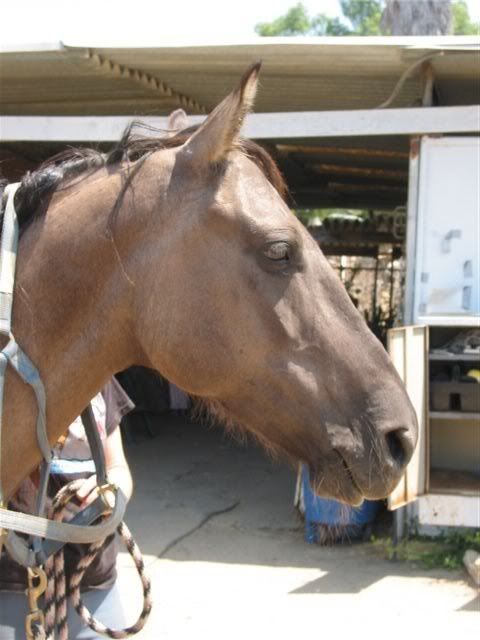
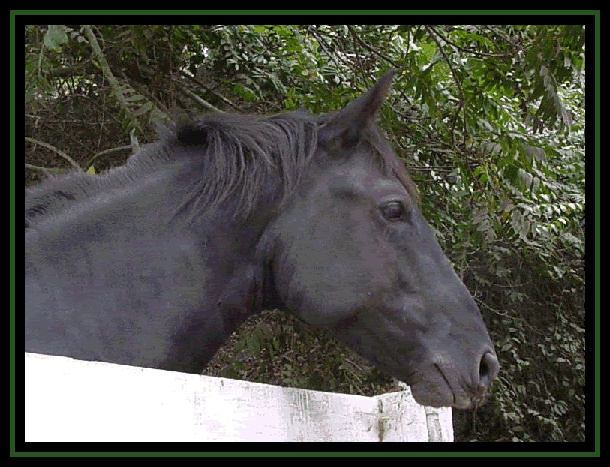
My thoughts on what old Iberian heads would be this: short in length, broad between the eyes, a straight (which usually gives the impression of roundness) or SLIGHTLY convex. The forehead most often being flat. The eyes should be large, almond shaped, and be broad between the eyes. The eyes will also have a bone arch above the eye. The width between the ears should also be broad. The ears should never be placed close together like what you would see on an Arab. The ear length should also not be long. Mares typically have longer ears than stallions or geldings. Mares would normally have medium to short ears and stallions and geldings should predominately display short ears. There also should not be a hook to the ear. The muzzle shouldn't be broad, but rather small. A 4 3/4" bit should be the perfect fit. The lips should be tight to the mouth. You often see big droopy lips on a draft horse. The nostrils should be crescent in shape and be able to expand greatly when the horse is being exerted. The chin on the horse should be small. The mandible should not convex out like what is typical to see on an Arab. The cheeks on both mares and stallions should not be protruding. The cheeks should look blend well on the face. The lips should come together to almost give the appearance that the horse's upper teeth going past the bottom teeth. This is commonly known as a "parrot mouth". In the old Spanish horse, there will be this "parrot mouth" appearance, BUT the horse's teeth will actually meet evenly.

La Victoria. This mare is displaying the width between the eyes as well as the ears. You can also plainly see the bone arches above her eyes.
This mare's head was damaged by a halter being left on while she was growing, so please excuse the slight dip on her head.


This is a stallion. I must note that this stallion is not displaying a nice large eye and he is also lacking the bone arch above his eye. When comparing to the other Sulphur horses on this post, you can better see it.

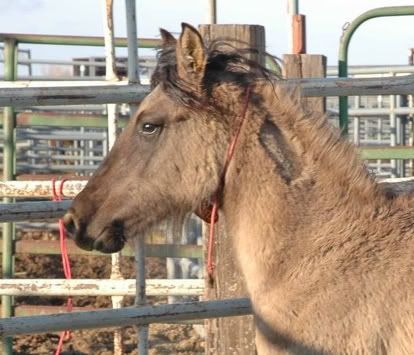
Young filly.
The famed Sulphur's Chance.
Sulphur's Chance