Sunday, April 5, 2009

Wild Horses of Utah's Mountain Home Range
part 3

Continuation of Ron Roubidoux's article on the Spanish Sulphur. Written in 1994.

"INTERVIEWS
I first interviewed Gale Bennett because of his familiarity with the Mountain Home Range through his work for the BLM since 1973. Gale was the first to tell me of the Pegleg Smith-Walkara story. He had read about the story in the book, "Claw of the Hawk". He later came upon the book "0ld Spanish Trail", which confirmed his theory of where the horses came from. Gale believes that the horses were brought into the area by the Ute Indians. Not only from Walkara's exploits, but also from the Ute's hunting and gathering pine nuts in the area. During helicopter flights,.Gale has seen circular rock pits, 35 to 50 feet in diameter, and in a row . He says these were use by Indians to cook the pinion pine cones from which the pinion nuts were used for food. He has also seen many arrow head chippings in the area.
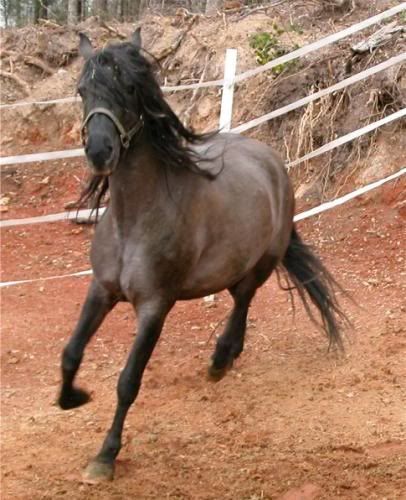
BR Lakota's Dreamweaver

I asked Gale if there was a difference in the Sulphur horses compared to those horses from other herd management areas. He said that they are a little bit smaller and more intelligent; they are afraid of people when first caught, but gentle down quick and accept people quicker than horses in other areas; and they are built stronger than other horses and have nicer heads. I asked if there were many dun factor horses in the other herds in Utah. He said, "No, that's one definite difference, at least in that bunch, is the coloring, of the buckskin (line backed), the dun, and the grulla, and that, we do not have in any other areas."

Glenn Foreman had told me that the Sulphur horses were wiser than horses in other herd management areas and were therefore harder to catch. I asked Gale about this and he said, "I think they are in an area that's harder to trap more than they are hard to trap. They're in an area where there's juniper- pinion.trees just so thick. The terrain, the timber, the country there is just definitely harder to trap horses in."
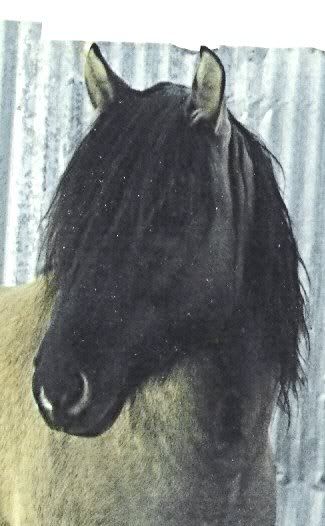
Craig Egerton told me, he noticed that when the horses are first caught, branded, and worked on, they sulk, lay down, and actually make a whimpering sound. This, to me, seems to be a typical reaction to captivity of an animal that exhibits a truly wild behavior. He also said that he heard that mustangers and local people left the horses alone because of their color and uniqueness. He told me of four Pryor Mountain horses that were put in with the Sulphur horses years ago. The Sulphur horses wouldn't accept them and the Pryor Mountain horses ran alone, at least for the years that the BLM could keep track of them.

Kent Gregersen, from Marysvale, Utah, first went into the Mountain Home Range in 1944, when he was fourteen years old. Kent became a mustanger in later years and caught many horses out of the area. He did a lot of mustanging in Nevada and Utah, where he caught and sold many horses. Kent recognized there was something unique about the Mountain Home horses, and after catching some, had them inspected by Bob Brislawn, founder of the Spanish Mustang Registry. These horses were confirmed as Spanish and were registered in the registry. Kent said that Bob Brislawn traded three horses for a buckskin-colored, line-backed Mountain Home stallion he had caught. This stallion was named Doby. Dr. William Stabler, president of the SMR, wrote to me and said he was the one that inspected Doby for registration. Marye Ann Thompson, registrar for the SMR, sent me some photos of Doby, and he looks typical of the Mountain Home horses. Kent told me that the only horses that he ever kept during his mustanging years were those from the Mountain Home Range: "They were a more intelligent horse, had more speed, and more cow savvy."
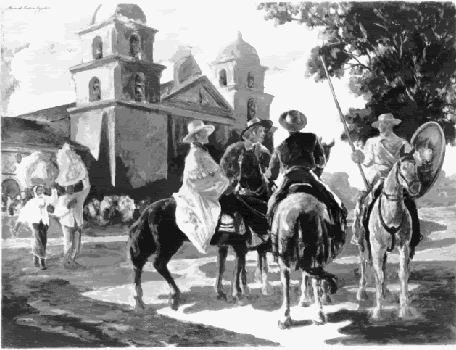
Painting of 1700's Spaniards and their horses in southern California.

Kent says that from the late 1930s to the early 1950s there were from 3,000 to 4,000 wild horses in the area, and most were caught by mustangers for the meat market. He said that many ranchers put domestic horses in with the wild ones to try to increase the size of the horses through cross breeding, but: "The little mustang studs would kill the domestic' stallions, and those that survived didn't adapt. They got sore footed, got down in condition, and winter killed. So, there has been a retention of the old original blood lines." I asked Kent if the domestic horses could have been those that were caught out in the early days, and the Spanish type horses, which were isolated in the mountains, were left undisturbed. He said, "Definitely." He also said the domestic horses would not mix with the Spanish type horses.

In Minersville, Utah, I interviewed 81 year old Cheryl Carter, 74 year old Daisel Davis, and 63 year old Nole Wood. Cheryl Carter said that the horses have been there all his life, and knew of no other outside horses being brought in. Daisel Davis started going into the Mountain Home Range when he was 19 years old. As far as he knows they are all Spanish mustangs, and there have never been any other horses mixed in with them. He said there have always been the buckskins and other colored horses, and a few pintos were there but they aren't there anymore. He said, "The horses have been, more or less, where nobody else is." Nole Wood also said that the horses have been there all his life, and specifically mentioned them as being buckskin with a black line down the back and having a black mane. He knew of no ranchers turning horses in with the Mountain Home horses, and felt they were pure. He said, often, that they are smarter than other horses. Nole also said his father told him that they have always been the same color, and in Pine Valley there was a thousand head of horses at one time, but the Spanish type horses were up in the hills all by themselves.
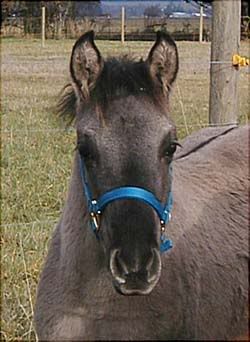
Sulphur's Corderio Riscado (Sulphur's Corderio Cruz x Sulphur's Arista)

What few people I was able to talk to in Milford, Utah, who knew anything about the horses, thought they came from the Dominguez- Escalante expedition. There is a park in Milford with a display telling about the expedition, so I'm sure that is how these people got the notion of where the horses came from.

Lad Davies is a rancher whose land is south of Garrison, Utah, in Hamblin Valley on the northwest side of the Mountain Home Range. He has been there for 63 years. He tells of draft horses being turned out with the wild horses before 1950, but none being turned out after 1950. This, he says, was an attempt by ranchers to increase the size of the wild horses. He believes that at most five percent of the wild horses bred with the domestic horses, but any cross breeding has never shown in the horses. He said, "I'd say these horses are ninety-five percent straight mustang, and I think you can go there and eyeball them, and someone that was knowledgeable could pick every one of them out, and that's my opinion." He went on to say, "These tame horses here all ran in the valley and all the wild horses ran in the mountains because the tame horses feet wouldn't stand up in the mountains, but they did mix a little, not a lot."

When I interviewed Gale Bennett, I asked for his opinion of the horses in the Sulphur unit as far as the Spanish ancestry goes? He answered, "I think these horses are the closest thing to the Spanish horses there are in the United States or in this continent, in my opinion." On the other hand, I interviewed Carl Mahon, a retired BLM employee from Montecello, Utah, over the telephone, and he didn't think there were any full-blooded Spanish horses left.
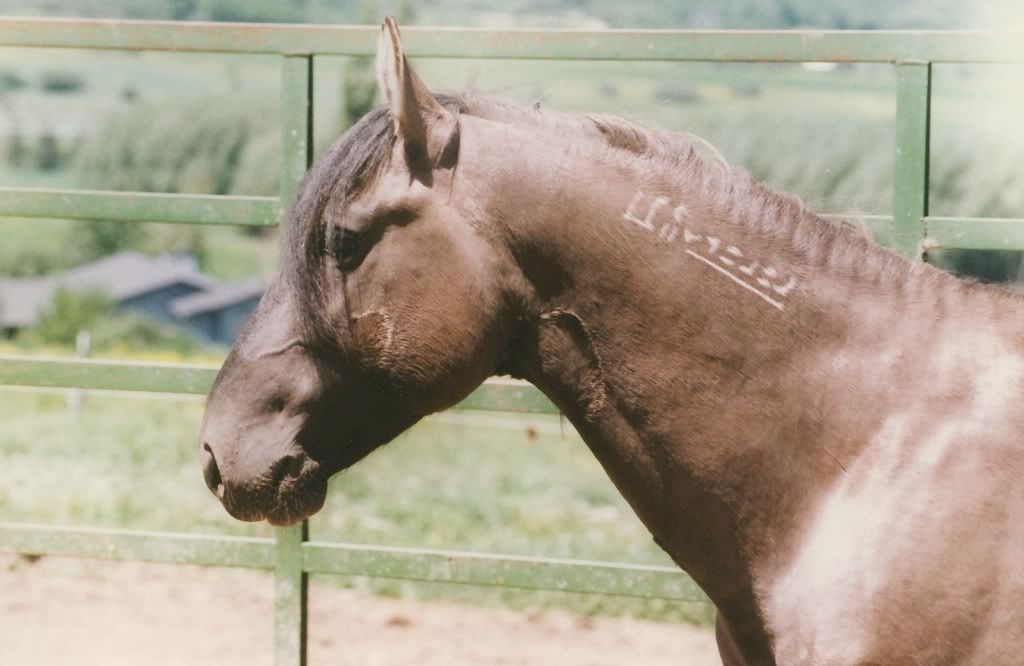
Takita

I have found, during interviews and discussing Spanish type horses with various people, that much is based on both assumption and personal opinion. Some people think a group of horses are of Spanish descent while others think not. Everyone has their own opinion, which varies as much as there are different colors in Spanish horses. It is therefore understandable that besides a history, the appearance and blood-type of the horses in question are important. Also, "in my opinion," one needs to weigh the evidence and put logic to work.

Wood also said that the horses have been there all his life, and specifically mentioned them as being buckskin with a black line down the back and having a black mane. He knew of no ranchers turning horses in with the Mountain Home horses, and felt they were pure. He said, often, that they are smarter than other horses. Nole also said his father told him that they have always been the same color, and in Pine Valley there was a thousand head of horses at one time, but the Spanish type horses were up in the hills all by themselves.

What few people I was able to talk to in Milford, Utah, who knew anything about the horses, thought they came from the Dominguez- Escalante expedition. There is a park in Milford with a display telling about the expedition, so I'm sure that is how these people got the notion of where the horses came from.
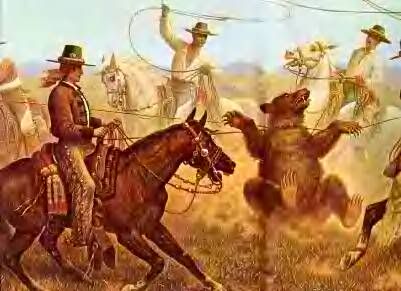
Spaniards roping a bear.

Lad Davies is a rancher whose land is south of Garrison, Utah, in Hamblin Valley on the northwest side of the Mountain Home Range. He has been there for 63 years. He tells of draft horses being turned out with the wild horses before 1950, but none being turned out after 1950. This, he says, was an attempt by ranchers to increase the size of the wild horses. He believes that at most five percent of the wild horses bred with the domestic horses, but any cross breeding has never shown in the horses. He said, "I'd say these horses are ninety-five percent straight mustang, and I think you can go there and eyeball them, and someone that was knowledgeable could pick every one of them out, and that's my opinion." He went on to say, "These tame horses here all ran in the valley and all the wild horses ran in the mountains because the tame horses feet wouldn't stand up in the mountains, but they did mix a little, not a lot."

When I interviewed Gale Bennett, I asked for his opinion of the horses in the Sulphur unit as far as the Spanish ancestry goes? He answered, "I think these horses are the closest thing to the Spanish horses there are in the United States or in this continent, in my opinion." On the other hand, I interviewed Carl Mahon, a retired BLM employee from Monticello, Utah, over the telephone, and he didn't think there were any full-blooded Spanish horses left.

I have found, during interviews and discussing Spanish type horses with various people, that much is based on both assumption and personal opinion. Some people think a group of horses are of Spanish descent while others think not. Everyone has their own opinion, which varies as much as there are different colors in Spanish horses. It is therefore understandable that besides a history, the appearance and blood-type of the horses in question are important. Also,
"in my opinion," one needs to weigh the evidence and put logic to work."

Saturday, April 4, 2009

Kentucky Horse Park

I am looking for a well trained Spanish Sulphur horse of good type to represent the Spanish Sulphur horse at the Kentucky Horse Park. Please email me if you know of a horse or own a horse that would be suitable for promoting the breed at that famous horse park.

weyekin@hotmail.com

Thursday, April 2, 2009

Wild Horses of Utah's Mountain Home Range
part 2

by Ron Roubidoux March 1994

"LITERATURE
The earliest reference to horses being in the southwestern Utah area is from the journal made by Father Silvestre Velez de Escalante during the 1776 Dominguez-Escalante expedition. Horses were referred to were those taken on the expedition. Herbert E. Bolton has an article entitled "Pageant in the Wilderness", in Utah Historical Quarterly in which he mentions that: "How many mules and horses the wayfarers had is not stated, but there must have been numerous extra mounts."

Escalante also refers to "the horse herd" in his journal, which would also suggest many animals. On October 2, while in an area south of Delta, Utah, the horse herd wandered off due to thirst, but was recovered. On October 8, in an area north of Milford, Utah, Escalante writes: "We traveled only three leagues and a half with great difficulty, because it was so soft and miry everywhere that many pack animals and mounts, and even those that were loose, either fell down or became stuck altogether." These were the only remarks concerning their horses during this time, but they were in areas fairly close to the Mountain Home Range. At this time they also encountered a very bad snow storm with accompanying strong winds and cold temperatures. Some horses possibly escaped, but there is no record of it.
Sulphur's Anhur Maximus as a colt. Year 2000.


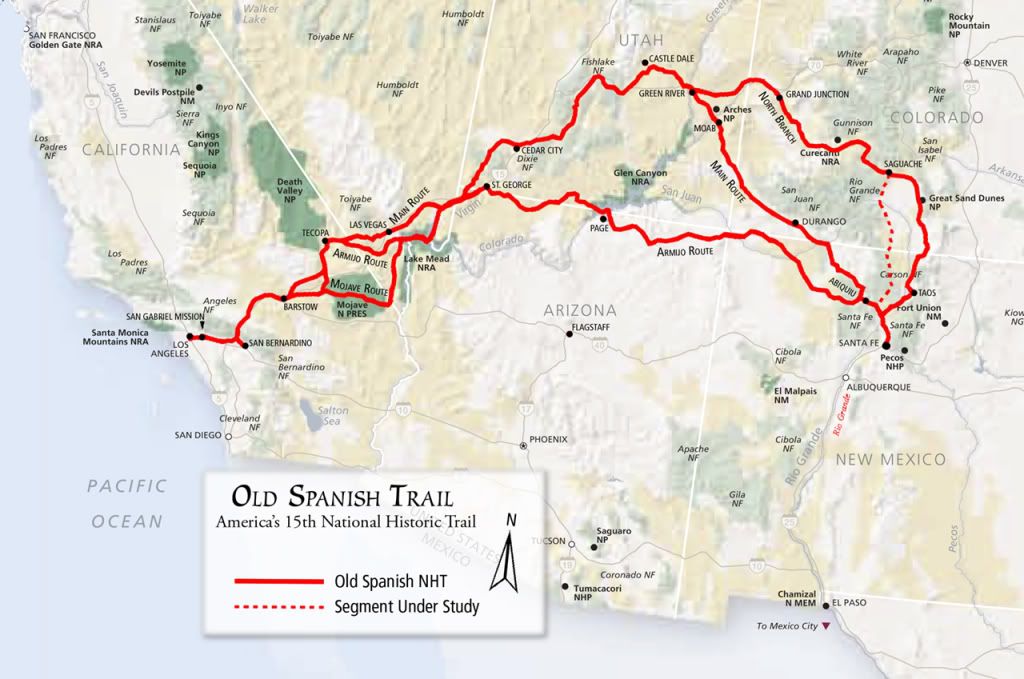
Gale Bennett, Wild Horse Specialist for the BLM's Richfield District, also has an interest in the Mountain Home Range's Spanish type horses. He has been looking for books about their history. Three months ago he introduced me to a book that I feel holds the key to where these horses came from. The book,"Old Spanish Trail", by Leroy R. Hafen and Ann W. Hafen was first published in 1954, and is again in print from Bison Book Company. The Hafens extensively researched the history of the Old Spanish Trail, which was the main trade route linking Santa Fe, New Mexico to Los Angeles, California from 1830 to 1848.According to the Hafens: "The Old Spanish Trail was the longest, crookedest, most arduous pack mule route in the history of America. Envisioned and launched in the late 1700s to serve as a connecting link between two of Spain's colonial outposts, the Trail reached its short- lived heyday in the 1830s and '40s, when annual caravans packed woolen blankets from New Mexico to trade for California horses and mules." Literally thousands of horses were driven over this trail from southern California to New Mexico. Part of the route led across the Escalante Desert, south of the Needle Range.
Photo by Bev Pettit Photography.


Many horses were obtained by men such as Antonio Armijo who was actually the first to start legal trade over the trail in 1830. Other accounts mentioned in the book were of John Rowland leaving Cajon Pass with 300 horses on April 7, 1842, followed by 194 New Mexicans, on April 16, with 4,150 animals legally acquired; James P. Beckwourth with 1,800 horses in 1844; and Joe Walker with four or five hundred horses and mules in the spring of 1846.

Much is discovered in "0ld Spanish Trail's" chapter on "Horse Thieves" where the Hafens write: "Although the value placed on wild horses was generally low, the tame stock in use at missions and ranchos and the mules, produced by careful breeding, were more highly prized. Loss of tame animals by theft was always a matter of concern. Soon the more irresponsible traders and certain adventurers found it easier to obtain livestock by raid than by trade. By 1832 raids on the herds of missions and ranches had become so frequent and devastating that Californians were alarmed." The Hafens give examples of many illegal raids, but the most spectacular one was that of Pegleg Smith and Ute Indian chief, Walkara, in 1840. Apparently, raids on California horse herds were many during this time, and Ute Indian raids did not cease until Walkara's death in 1855."
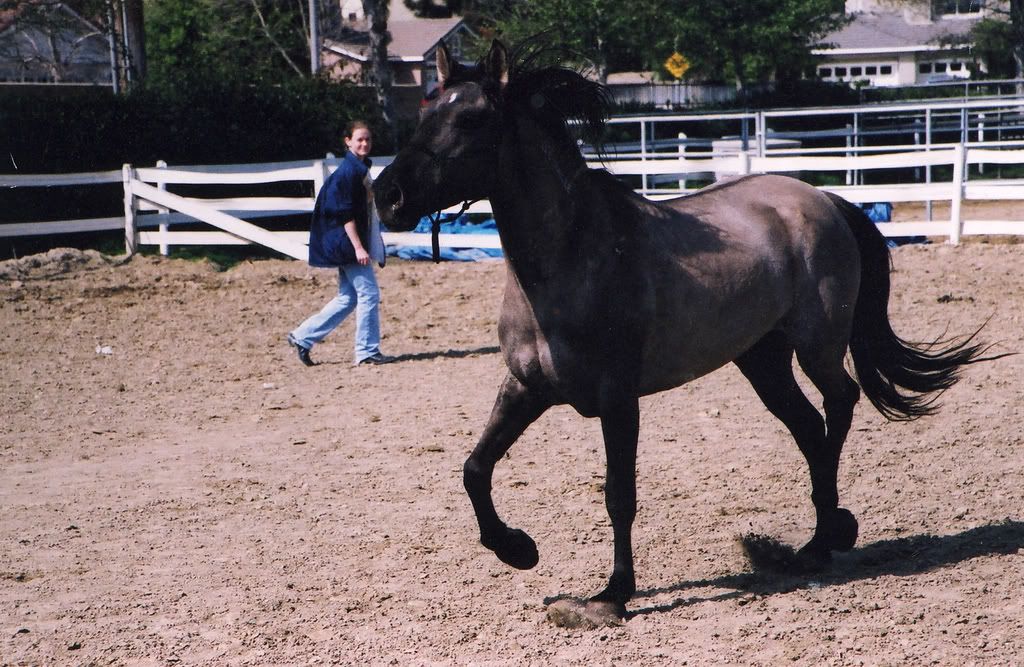
La Victoria. Los Angeles Equestrian Center 2004


In the 1954 book, "Walkara, Hawk of the Mountain", by Paul Bailey, more detail is written into before, during, and after the 1840 raid in southern California. The book mentions Walkara's part in the Indian slave trade and how he was feared by lesser tribes without horses.

Robert M. Denhardt tells of the 1840 horse raid in his book, "The Horse of the Americas". His rendition of the story is quite good. He states that though the thieves initially got away with 3,000 horses, the Californians recaptured 1,200. He also writes: "As a rule, stolen horses were sold in Utah or taken directly to Santa Fe." He writes of Miles Goodyear, in the spring of 1848, driving 230 legally acquired horses from southern California into Utah. Goodyear traveled across the Escalante Desert north to the Sevier River. Of significance in Denhardt's story is a statement that can probably be applied to all the herds of horses driven across the Old Spanish Trail: "When first leaving California, they (the horses) must have taken every opportunity to bolt for the thickets and any other likely-looking chance which might mean freedom."

Map of the Old Spanish Trail.

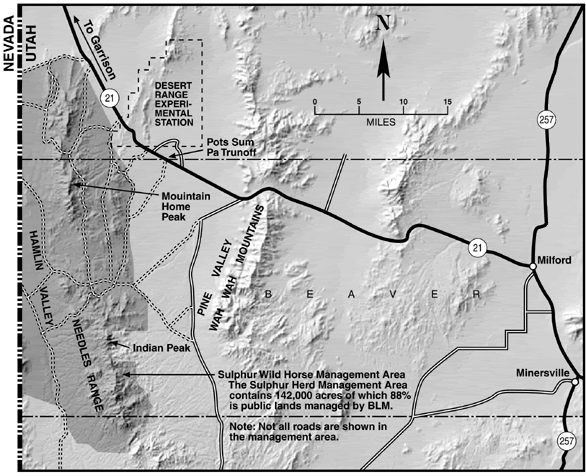
Map of the Sulphur HMA.

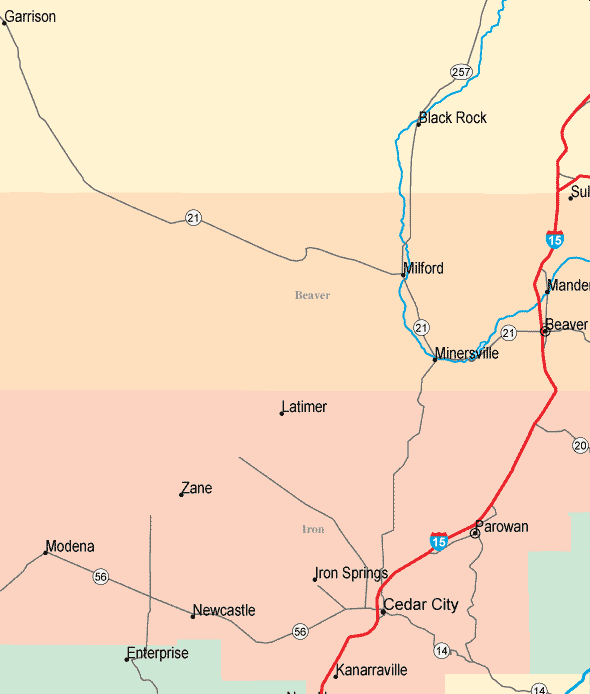
You can see here on this close up of the Utah map where the Sulphurs are. Compare all three of these images to get an idea how close the Old Spanish Trail is to the Sulphur HMA.


"These books document well how Spanish horses could have populated the southwestern Utah area. I have found no references of any other breeds of horses coming into or establishing a population in the area before settlement. "

Monday, March 30, 2009

Picture from the Past

Here is La Victoria in her Spanish show halter. Photo was taken sometime in 2003.

Iberian Warmblood Registry International

Just to give you all an update. The Iberian Sport Horse Registry that was accepting the Spanish Sulphur as a foundation parent has merged with the Iberian Warmblood Registry. To confirm that the IWRI will also accept this old Spanish breed as a founding parent (same as the Andalusian and Lusitano), I had emailed them. Here is what a received back:

Re: Question for Registration‏
From: Iberian Warmblood Registry International, LLC (Registry@IberianWarmblood.com)
Sent: Sat 3/28/09 12:48 PM
To: Kimberlee Jones (weyekin@hotmail.com)

Yes - horses from the sporthorse registry have been merged with the IWRI. The registry will broaden to include Sulphurs.

So, any of you with Sulphur crosses can register your horse(s) as an Iberian Warmblood!

Friday, March 27, 2009

Wild Horses of Utah's Mountain Home Range
part 1

Written by Ron Roubidoux in 1994.

"The Mountain Home Range lies at the north end of the Bureau of Land Management's Sulphur Herd Management Area, which is located in southwestern Utah. Craig Egerton, Supervisory Range Conservationist for the BI~'s Beaver River Resource Area, says that most maps show the entire north and south running range as the Needle Range, but local people break it up into the Mountain Home Range on the north and the Indian Peak Range on the south. The highest elevation in the Mountain Home Range is 9,480 feet whereas Indian Peak has an elevation of 9,790 feet. The forty mile long Needle Range is covered with heavy stands of pinion and juniper, and is located east of the Nevada-Utah border. Hamblin Valley is on the west, Pine Valley is on the east, and the Escalante Desert is on the south. Antelope Valley, the Burbank Hills, and Great Basin National Park are on the north.

Elevations of the surrounding valley floors are between 5,000 and 6,000 feet. From the dry, lifeless hardpan of the valley floors the land gently rises over native grass covered flats to sagebrush covered benches, and finally to the pinion-juniper covered mountains. Benches and mountains are broken up with many rugged canyons and draws. Low areas are generally sandy while the mountain slopes are very rocky. The Sulphur Herd Management Area is approximately 142,800 acres, and covers the entire Needle Range. Most of the area is unfenced.

Gus Warr, Range Conservationist for the BLM's Beaver River Resource Area, says there is an imaginary line between Vance Spring and Sulphur Spring which divides and separates the horses in the Sulphur Herd Management Area. The area between these springs also divides the Mountain Home Range from the Indian Peak Range. Both Craig and Gus have said that most of the Spanish type horses are found north of this line on the Mountain Home Range. The BLM is therefore managing this area specifically for the Spanish type horse. The herd management area gets its name from the Sulphur Springs. There are three springs in all, North Sulphur Spring, South Sulphur Spring, and Sulphur Spring. Many other springs are found throughout the Needle Range.
Santiago. Photo by Diane Black owned by Deb Baumann of California

According to D. Philip Sponenberg, DVM, PhD, of Virginia-Maryland Regional College of Veterinary Medicine and Technical Coordinator, American Livestock Breeds Conservancy: "The three main tools for evaluating horses (for Spanish descent) are the history behind the individual horse, the appearance of the horse, and the blood-type of the horse." During August 1993, Dr.Sponenberg came to Utah and inspected thirty-four Sulphur horses that the BLM had adopted out to various individuals. His subsequent evaluation states: "The Sulphur Herd Management area horses that are present as adopted horses in the Salt Lake City area appear to be of Spanish phenotype. The horses were reasonably uniform in phenotype, and most of the variation encountered could be explained by a Spanish origin of the population. That, coupled with the remoteness of the range and blood-typing studies, suggests that these horses are indeed Spanish. As such they are a unique genetic resource, and should be managed to perpetuate this uniqueness. A variety of colors occurs in the herds, which needs to be maintained. Initial culling in favor of Spanish phenotype should be accomplished, and a long term plan for population numbers and culling strategies should be formulated. This is one population that should be kept free of introductions from other herd management areas, as it is Spanish in type and therefore more unique than horses of most other BLM management areas." He later states: "The horses removed during the last few years from the Sulphur Herd Management Area are Spanish in type. The fact that the horses were so consistently Spanish type is evidence that these horses have a Spanish origin," This evaluation therefore establishes the Sulphur horses as Spanish in appearance.
Rose and filly Maria. Photo taken by Joseph Hayes and owned by Victoria of California.

Concerning blood-typing, Dr. Sponenberg's evaluation states: "Gus Cothran has blood-typed a small number of these horses, and is struck by the frequency of antigens known to be of Spanish origin. While further sampling would be useful, he is confident that this population will ultimately prove to be one of the more consistently Spanish of feral populations so far studied." E. Gus Cothran, PhD, Director, Equine Blood-Typing Research Laboratory, University of Kentucky, sent me a letter where he writes: "The Sulphur herd in general appears to have strong Spanish links. What I can tell you is that the Sulphur horses have the highest similarity to Spanish Type Horses of any wild horse population in the U.S. that I have tested. They definitely have Spanish ancestry and possibly are primarily derived from Spanish Horses. However, I have not done an intensive analysis of these horses yet. The southwestern Utah horses look to be a very interesting group and I hope I have an opportunity to do more work with these horses." He also told me, during a telephone conversation, that he needed more blood samples to do a proper evaluation of the Sulphur horses. Glenn Foreman, Public Affairs Officer for the BLM's Salt Lake District, planned on a voluntary gathering of adopted Sulphur horses in April 1994, where blood would be taken from horses and sent to Kentucky for more blood-typing. This would have fulfilled the number of samples required for Dr. Cothran to make a final evaluation of the horses. Unfortunately, due to a glitch in the BLM's budget, higher powers in the BLM canceled the funding for Glenn's project. Glenn told me that this set back was temporary, and he eventually wants to have the work done. Although the evaluation for blood-typing still needs to be completed, the work that has been done thus far looks good.This leaves the history of the horses to be established. Again, Dr. Sponenberg writes in his evaluation: .Detailed historical background of the Sulphur Herd Management Area horses is not available. The limited amount of history available points to population being an old one, with limited or no introduction of outside horses since establishment of the population. Foundation of the herd is logically assumed to be Spanish, since this the only resource available at the time of foundation.
Sulphur's Anhur Maximus. Grandson of Sulphur's Chance.

My purpose in writing this paper is to try to establish a background history for the wild horses of the Mountain Home Range, and logically reinforce their case for purity of Spanish descent."

A Little History

D. P. Sponenberg, DVM, PhD, Veterinary College, VPI, Blacksburg, VA 24061

Dated 1993

"The Sulphur herd management area in Southwest Utah is one area that still has Spanish type horses today. This region is along the Old Spanish Trail trade route, along which many horses traveled during Spanish and later times. Both traders and Ute Indians used routes through the area repeatedly, and the feral horses are thought to have originated from this source. Chief Walkara and others made many horse raids into California, and it is likely that the horses in this region have a California origin, making them distinct from other feral strains. Many of the horses from the northern end of this management area have very Spanish type. The usual colors in these herds are dun, grullo, red dun, bay, black and a few chestnuts. These horses show remarkable adaptation to their harsh environment. These horses are currently attracting attention, as well as dedicated breeders such as Ron Roubidoux. A group of these horses was accepted into the SMR in 1994, and a second group in 1995. The horses remaining in the wild are in a remote area, and these horses are frequently harassed by a variety of people. Hopefully the ones in the feral herds can be managed to complement the very able work being done by Ron and the other breeders. Bloodtyping by Gus Cothran has revealed a very high frequency of Iberian markers in the Sulphur horses."